Key takeaways
- check_circle Pneumonia is an infection of the lungs where the air sacs fill with fluid or pus — making breathing painful and difficult.
- check_circle In Karimnagar, people with dust-damaged lungs, COPD, diabetes, and the elderly are at significantly higher risk of severe pneumonia.
- check_circle It can be caused by bacteria, viruses, or fungi — and the treatment depends on which one is responsible.
- check_circle Not all pneumonia needs hospitalisation — mild cases can be treated at home with the right antibiotics. But some cases are emergencies.
- check_circle Two vaccines — pneumococcal and influenza — can dramatically reduce your risk of severe pneumonia.
- check_circle Completing the full antibiotic course is non-negotiable. Stopping early leads to relapse and antibiotic resistance.
What is pneumonia?
Your lungs contain millions of tiny air sacs called alveoli — each one a microscopic balloon that fills with air when you breathe in and transfers oxygen into your blood while removing carbon dioxide. This is the fundamental act of breathing.
In pneumonia, these air sacs become infected and inflamed. They fill with fluid, pus, and cellular debris instead of air. When enough alveoli are affected, the lungs cannot do their job — oxygen cannot enter the blood efficiently, and breathing becomes laboured and painful.
Pneumonia can range from mild — managed at home with oral antibiotics — to severe and life-threatening, requiring intensive hospital care and oxygen support. The same infection that keeps one person in bed for a week can put another person on a ventilator. The difference lies in the health of the person's lungs and immune system before infection.
This is why Karimnagar's population is at particular risk. Lungs already damaged by years of coal dust, fly ash, silicosis, or COPD are compromised defences. When pneumonia strikes these lungs, it finds less resistance and causes more damage. Add the region's extreme summer heat — which causes dehydration and thickens mucus — and you have conditions that make pneumonia both more likely and more dangerous.
Who is at risk?
Anyone can get pneumonia — but these groups face a significantly higher risk of severe disease:
- check_circle Coal mine and power plant workers — dust-damaged lungs have impaired natural defences; bacteria establish infection more easily.
- check_circle People with COPD, asthma, or silicosis — existing lung disease increases both risk and severity.
- check_circle People with diabetes — high blood sugar impairs immunity; diabetics get sicker faster and recover slower.
- check_circle The elderly (over 65) — immune function declines with age, and the cough reflex weakens.
- check_circle Bidi and cigarette smokers — smoking destroys the lungs' natural bacterial clearance system.
- check_circle People who are malnourished — poor nutrition means poor immunity.
- check_circle Heavy alcohol users — alcohol impairs immunity, the cough reflex, and clearance of aspiration.
- check_circle Bedridden or hospitalised patients — immobility lets secretions pool; hospitals expose patients to resistant bacteria.
- check_circle Young children under 5 — developing immune systems; pneumonia is the leading infectious cause of child death globally.
- check_circle People recovering from influenza — the flu virus damages the airway lining, opening the door to bacterial pneumonia.
Symptoms to watch for
Pneumonia symptoms can appear suddenly (over 24–48 hours) or develop gradually over several days. Common symptoms include:
- check_circle Fever — often high, above 38.5°C, with chills and shaking
- check_circle Cough — usually productive, bringing up green, yellow, rust-coloured, or blood-tinged mucus
- check_circle Chest pain — sharp or stabbing, often worse with breathing or coughing (pleuritic pain)
- check_circle Shortness of breath — even at rest in moderate to severe cases
- check_circle Severe, sudden fatigue disproportionate to a common cold
- check_circle Rapid breathing and heart rate, sweating, clammy skin
- check_circle Confusion or mental fogginess — in the elderly this may be the first and only obvious sign
Some younger, otherwise healthy people have 'walking pneumonia' — usually caused by Mycoplasma pneumoniae. Symptoms are milder (persistent dry cough, low-grade fever, fatigue) but it still needs antibiotic treatment, just a different type.
High fever, chest pain when breathing, and significant breathlessness together mean one thing — see a doctor today. Do not wait this out at home. Suspected pneumonia? Book an urgent evaluation with Dr. Praveen in Karimnagar.
How is pneumonia diagnosed?
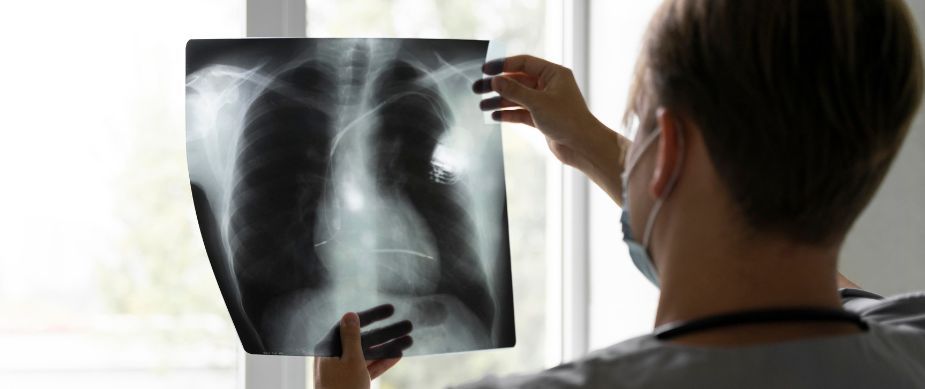
Chest X-ray — the cornerstone of diagnosis. Infected areas appear as white or grey shadows (consolidation). In patients with silicosis, COPD, or old TB scars, interpreting the X-ray needs an experienced pulmonologist's eye.
Blood tests — a full blood count (white cells rise in bacterial pneumonia), CRP and ESR for inflammation, blood cultures to check for bacteria in the bloodstream, and procalcitonin to help separate bacterial from viral infection.
Sputum test — a mucus sample is cultured to identify the exact bacteria and which antibiotics it responds to, important when initial treatment is not working.
Pulse oximetry — oxygen saturation below 94% is concerning; below 90% is an emergency needing hospitalisation. A CT scan is used when X-ray is unclear or complications (abscess, effusion) are suspected.
Severity scoring — tools like CURB-65 (age, confusion, breathing rate, blood pressure, blood urea) help decide whether a patient can be treated safely at home or needs admission. Dr. Praveen uses these alongside clinical judgement.
How is pneumonia treated?
Most community-acquired pneumonia is bacterial — commonly Streptococcus pneumoniae — and is treated with antibiotics. Mild to moderate cases treated at home typically use amoxicillin or amoxicillin-clavulanate, azithromycin or doxycycline for atypical organisms, or a respiratory fluoroquinolone when broader cover is needed.
Severe pneumonia in hospital is treated with intravenous antibiotics, often in combination, stepping down to oral once stable. The critical rule: complete the full course — typically 5–7 days for mild cases, up to 14 days or more for severe ones. Stopping early lets surviving bacteria regroup and drives resistance.
Viral pneumonia (including influenza) may need antivirals such as oseltamivir, particularly when started early; COVID-19 pneumonia has its own protocols.
Supportive hospital care includes supplemental oxygen, IV fluids, nebulised bronchodilators, chest physiotherapy, high-flow oxygen or BiPAP for severe respiratory failure, and mechanical ventilation in the most critical cases.
For mild pneumonia managed at home: take every antibiotic dose on time and finish the course, rest, stay well hydrated, take paracetamol for fever, avoid smoking entirely, and return immediately if breathlessness, fever, confusion, or bluish lips develop.
Preventing pneumonia — vaccines that work
Pneumonia is significantly preventable. The pneumococcal vaccine protects against Streptococcus pneumoniae and is strongly recommended for all adults over 65, people with COPD, asthma, diabetes or heart disease, smokers, and mine or power plant workers with chronic lung conditions.
The annual influenza (flu) vaccine protects against influenza viruses and — critically — reduces the flu-then-bacterial-pneumonia combination responsible for some of the most severe cases. Ask Dr. Praveen about pneumonia vaccination at your next visit in Karimnagar.
Recovery
Recovery takes longer than most patients expect, and pushing too hard too soon leads to relapse. Fatigue can persist for 4–6 weeks even after the X-ray clears — this is normal. Return to work gradually, especially for workers in dusty environments. Eat protein-rich food, stay hydrated, and do not return to smoking.
Dr. Praveen typically arranges a repeat chest X-ray 6–8 weeks after treatment to confirm complete clearing. In high-risk patients — smokers, mine workers, those over 50 — a shadow that does not clear fully needs further investigation.
Common myths — busted
'Pneumonia is just a bad chest cold and will pass on its own.' False. Bacterial pneumonia does not resolve without antibiotics, and in people with existing lung damage, diabetes, or older age it can deteriorate rapidly.
'I was given antibiotics, so I can stop once I feel better.' False and dangerous. Feeling better after 3–4 days means the medicine is working — not that the job is done. Complete every dose.
'Pneumonia only affects old or very sick people.' False. Young, healthy people get pneumonia too — but severity is much greater in high-risk groups. 'The pneumonia vaccine gives you pneumonia.' False — vaccines contain no live organisms and cannot cause the disease.
When is it an emergency?
Book an appointment if you have had fever with cough and shortness of breath for more than 2–3 days, your mucus has changed colour, you have chest pain when breathing, you are a high-risk patient with any chest infection, or you have not fully recovered two weeks after completing antibiotics.
Go to emergency immediately if oxygen levels drop (lips or fingertips turning blue), breathing becomes very rapid or laboured (unable to speak in full sentences), there is high fever with confusion in an elderly person, a child's chest visibly caves in between the ribs, or a known pneumonia patient suddenly worsens despite treatment.
Dr. Praveen's message
Pneumonia has a well-deserved reputation as a serious illness — and in our region, that reputation is earned. When I see a mine worker or a retired plant employee with pneumonia on top of already damaged lungs, I know we are in a race against time.
But here is what gives me hope: pneumonia is treatable — effectively and reliably — when it is caught early and the right medicines are started promptly. And with the right vaccines, many of these cases never need to happen at all. Fever, chest pain, breathlessness — come to me the same day. And please, get vaccinated. You have earned the right to breathe freely; let us protect that.
This article is for educational purposes only and does not replace personalised medical advice. Please consult Dr. Praveen for diagnosis and treatment specific to your condition.
Twelve years of pulmonology practice in Karimnagar. I write these articles for my own patients — plain language, no jargon, honest answers.