Key takeaways
- check_circle Asthma is a common lung condition where the airways narrow, swell, and produce extra mucus — making breathing difficult.
- check_circle In Karimnagar, fly ash from thermal plants, coal dust, extreme heat, and seasonal pollen are major triggers.
- check_circle Asthma affects children, women, and young adults — not just older workers. Anyone can develop it.
- check_circle Asthma is not curable — but it is completely controllable. Most patients can live a fully normal life.
- check_circle The biggest danger in our region is patients refusing inhalers out of fear. That fear costs lives.
- check_circle With the right plan from a pulmonologist, asthma attacks can be prevented — not just treated.
What is asthma?
Asthma is a chronic condition affecting the airways that carry air in and out of the lungs. In an asthma patient these airways are always slightly inflamed; when a trigger is met — dust, smoke, cold air, exercise — the inflammation spikes, the muscles around the airways squeeze tight, and thick mucus is produced. The result is the classic trio: chest tightness, wheezing, and breathlessness.
Unlike COPD, asthma is largely reversible — the airways can open back up on their own or with medication, which is why well-managed asthma need not limit your life. But uncontrolled asthma is dangerous: a severe attack can be life-threatening, and in Karimnagar's often poor air quality the risk of severe attacks is higher.
Who is at risk?
- check_circle Children with a family history of asthma or allergies
- check_circle People living near Singareni mines or thermal plants — fly ash and fine particulate matter trigger and cause asthma
- check_circle Workers with occupational exposure — miners, plant and construction workers can develop occupational asthma
- check_circle Bidi and cigarette smokers; people with eczema, hay fever, or food allergies
- check_circle Women during pregnancy or hormonal changes; anyone exposed to biomass cooking smoke
- check_circle People in Karimnagar during the hot, dusty April–June months
Symptoms to watch for
- check_circle Wheezing — a high-pitched whistling sound, especially while exhaling
- check_circle Sudden or activity-related shortness of breath; chest tightness or pressure
- check_circle A dry, persistent cough, especially at night or early morning
- check_circle Coughing spells after laughing, exercise, or exposure to cold air or smoke
- check_circle Poor control: night waking more than once a week, rescue inhaler use more than twice a week, symptoms interfering with daily life
Warning signs of a severe attack — act immediately: breathlessness so severe you cannot complete a sentence, no relief after 2–3 puffs of the rescue inhaler, bluish lips or fingertips, neck muscles straining to breathe, or drowsiness and confusion. A severe asthma attack is a medical emergency — do not wait and do not drive yourself.
How is asthma diagnosed?
Spirometry is the key breathing test, often done before and after a bronchodilator — if lung function improves significantly afterwards, that reversibility confirms asthma. A peak flow meter (usable at home) gives early warning of a worsening attack. Allergy testing identifies specific triggers, the FeNO test measures airway inflammation directly, and a chest X-ray rules out other causes such as pneumonia or heart failure.
How is asthma treated?
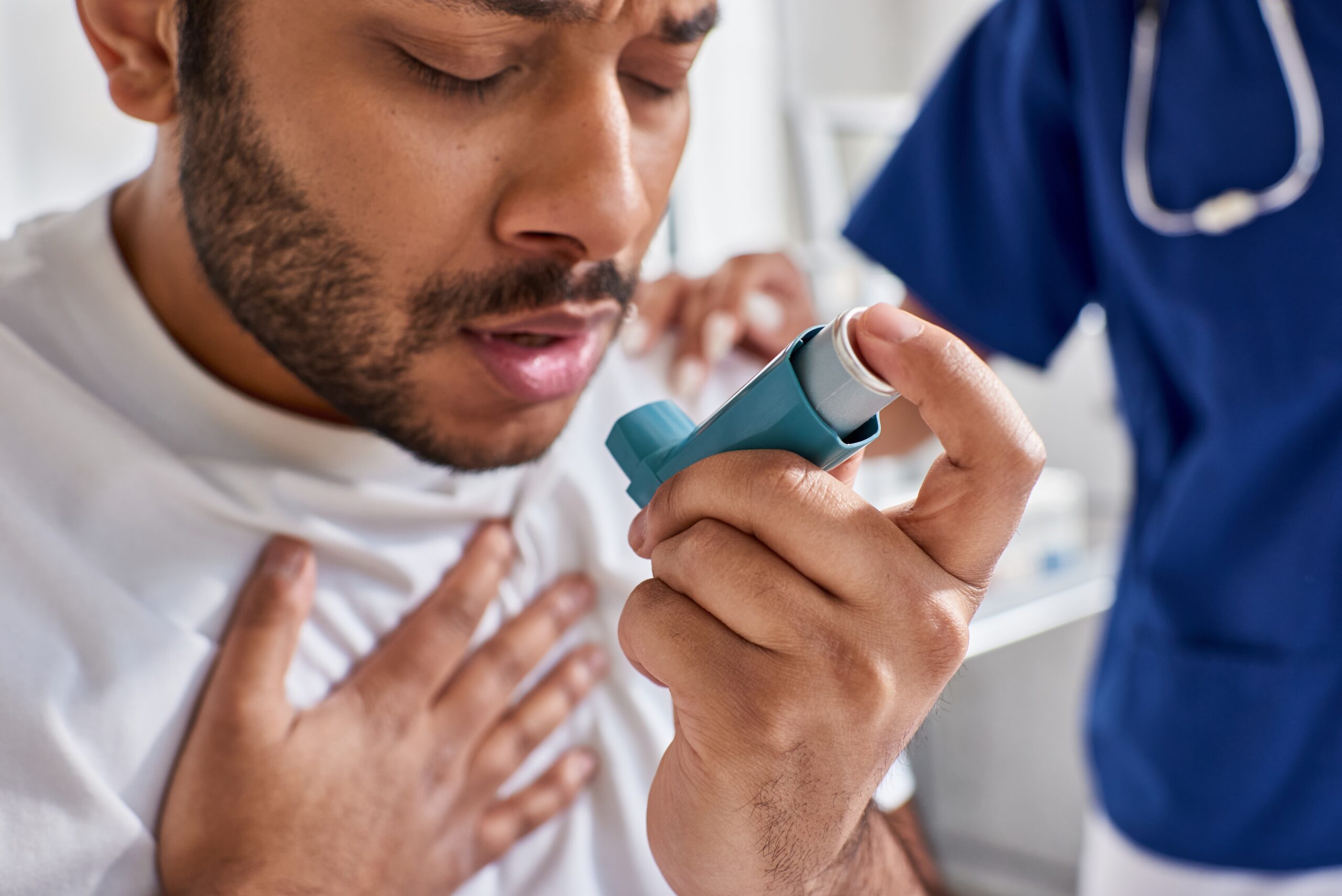
Treatment has two goals — relieve symptoms quickly and prevent them — needing two kinds of medicine. Reliever (rescue) inhalers are short-acting bronchodilators such as salbutamol that open the airways within minutes; needing one more than twice a week means asthma is not well controlled. Controller (preventer) inhalers — inhaled corticosteroids, or ICS+LABA combinations — are taken every day to reduce the underlying inflammation so attacks are less likely.
Nebulisation delivers high-dose medicine during a severe attack, useful for young children and the elderly. Montelukast tablets or short courses of oral steroids are added when needed, and allergen immunotherapy can reduce sensitivity in clearly allergy-driven asthma. Trigger avoidance is as important as medicine — N95 masks on high-dust days, quitting smoke exposure, switching to LPG cooking, avoiding strong smells, and using the rescue inhaler 15 minutes before exercise if needed.
Living with asthma
- check_circle Follow your written asthma action plan — green, yellow, red zones
- check_circle Never skip the controller inhaler, even when you feel completely fine — it works silently to prevent the next attack
- check_circle Keep a symptom diary to reveal triggers; monitor with a peak flow meter at home
- check_circle Inform your workplace and ask for reasonable protective measures near the mines or plant
- check_circle For children with asthma, ensure teachers know and keep a rescue inhaler at school
Common myths — busted
'Inhalers are addictive — I will become dependent on them.' False, and the single most dangerous myth about asthma in India. Asthma inhalers are not addictive in any way; refusing them leads to poor control, unnecessary suffering, and preventable deaths.
'Asthma goes away on its own — my child will grow out of it.' Partially false — many do not, and it often returns in adulthood. 'Inhalers are a last resort; I should try home remedies first.' False — inhalers are the first-line, evidence-based treatment. 'Asthma means I cannot exercise.' False — with a pre-exercise bronchodilator and a good plan, almost all patients can and should exercise.
When is it an emergency?
Book an appointment if you wheeze, cough, or feel breathless more than twice a week, symptoms wake you at night more than once a week, you use the rescue inhaler frequently, you have needed emergency care for asthma in the past year, your child often misses school for breathing problems, or you live or work near the Singareni mines or plants with any breathing symptoms.
Go to emergency immediately if breathlessness is severe and worsening rapidly, the rescue inhaler is not helping after 2–3 puffs, lips or fingertips are turning blue, you or your child cannot speak in full sentences, or the person is drowsy or losing consciousness.
Dr. Praveen's message
Asthma is one of the most treatable conditions I see — and one of the most mismanaged, because patients fear the inhaler more than they fear the disease. I see children who have not slept properly in months from nighttime coughing, young women who cannot walk to the market without stopping for breath, and mine workers who have accepted breathlessness as 'part of the job'. None of this has to be this way.
The air around our coal mines and power plants is harsh, and we cannot change that overnight — but we can protect every person who breathes it, with the right diagnosis, the right inhaler, and the right plan. You deserve clear, open airways. You deserve to breathe freely and live fully.
This article is for educational purposes only and does not replace personalised medical advice. Please consult Dr. Praveen for diagnosis and treatment specific to your condition.
Twelve years of pulmonology practice in Karimnagar. I write these articles for my own patients — plain language, no jargon, honest answers.